In recent years, certain engines equipped with oil-immersed timing belt systems have generated significant technical debate within the aftermarket. What was initially presented as an efficient solution in terms of reducing friction, noise, and emissions has, in some cases, led to premature failures and complex repairs.
Given this scenario, converting an oil-immersed belt system to a timing chain has become established as a viable technical alternative in certain applications. But what exactly does this conversion entail? What problems does it aim to solve? What risks are involved? And, above all, how should it be carried out correctly?
What is an oil bath system and why is it used?
An oil-bath timing system is a design in which the timing belt operates in direct contact with the engine oil. Unlike traditional dry-running belts, this configuration aims to:
-
- Reduce internal friction
-
- Decrease noise levels
-
- Improve energy efficiency
-
- Contribute to emissions reduction
From an engineering standpoint, the proposal makes sense. However, the reality of prolonged use has shown that this design requires very specific maintenance conditions and lubricant quality.
In certain engines constant contact with oil can cause:
-
- Premature belt material degradation
-
- Lubricant contamination with particles
-
- Oil passage blockage
-
- Timing failures
-
- Secondary damage to engine components
When accelerated degradation occurs, repair is not always simple or inexpensive.
Why propose a conversion to a chain?
The timing chain offers well-known advantages:
-
- Greater mechanical strength
-
- Reduced susceptibility to lubricant degradation
-
- Improved performance under high dynamic loads
-
-
Greater long-term dimensional stability.
-
In applications where the oil-immersed belt system has shown structural weaknesses or critical maintenance requirements, conversion to chain allows:
-
- Eliminate dependence on the integrity of the belt material
-
- Reduce the risk of internal disintegration
-
- Improve the stability of the timing system
-
-
Increase the perception of long-term reliability
-
This is not a simple replacement of components, but a reconfiguration of the distribution system.
What does the conversion technically consist of?
Converting an engine originally designed for a wet timing belt to a timing chain involves adapting several elements of the system:
-
-
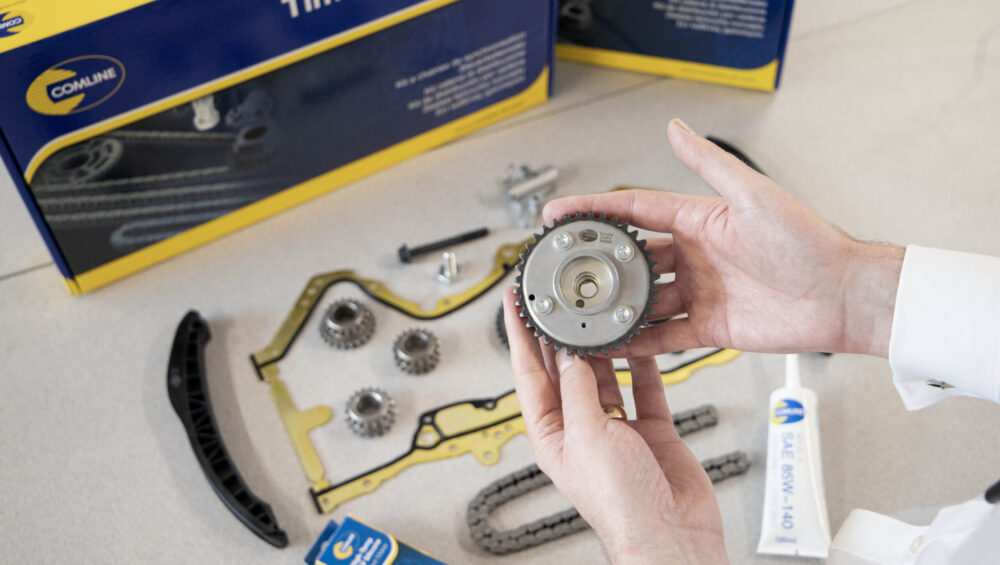
Replacing the flexible element (belt) with a chain designed to withstand the engine’s dynamic loads.
- Installing guides and tensioners specifically designed for a chain.
- Integrating a compatible sprocket system.
- Structural adaptation through a specific adapter that allows the new system to be housed correctly.
-
- Correct alignment.
- Proper tension.
- Even load distribution.
- Compatibility with the engine block and cylinder head.
What the installer must take into account
- Verification of the engine’s overall condition.
- Thorough cleaning of the lubrication circuit.
- Checking for possible residues resulting from the wet belt system.
- Inspection of tolerances and alignments.
- Replacement of all components associated with the timing system.
The technical solution: CTK011F
The CTK011F kit has been specifically developed to address this conversion in a structured and safe manner. Designed for Ford applications equipped with 1.8 TDCi engines (KKDA, RTN, and F9DA), the CTK011F kit offers coverage for models such as the C-Max, Fiesta, Focus, Galaxy, Mondeo, S-Max, Tourneo, and Transit Connect manufactured between 1998 and 2015.
This is not just an alternative, but a comprehensive solution designed to:
- Properly convert the engine from wet belt to chain.
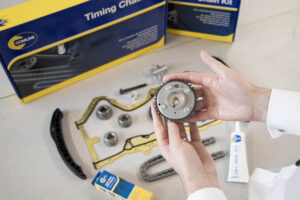
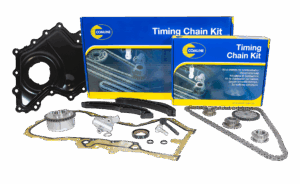
- Include all the components required for the transformation.
- Guarantee alignment and compatibility through a specific adapter.
- Provide a complete solution, avoiding improvisation.
More than a conversion: a reliability decision
- Reduces uncertainty.
- Minimises installation risks.
- Reinforces confidence in the final result.
- Protects the reputation of both the professional and the distributor.